Wednesday, July 11, 2012

Ideal Sail Quiver - 2

Hi

I will start with the biggest size and move down the range by size.  The first sail therefore, is the 9m.

What we don't want in this sail is some budget model which is not capable of performance sailing.  What we also don't want is a modern race sail with a huge wide sleeve, many battens and 4 or 5 cams.  These sails in the bigger sizes are a complete nightmare.  They are extremely heavy and really awkward to use.  These qualities  mean that they put huge strain on the body when they are sailed as they should be, and sailing them is nightmarish.  No fun at all!

What we do want is a fairly technical sail which is light, fast, easy to use and with plenty of bottom end power.  It should have a narrow sleeve and, as I said in the last post, may have cams to support the shape in light wind.

Cammed models to consider are Severne's Turbo, Gaastra's Cosmic and the Maui Sails Blaze.  Of these 3, I would choose the Blaze.  It has 7 battens and 3 cams, and weighs only 5.6kg.  They recommend a 520 mast but I'm pretty sure that their 490, 100% race mast would work beautifully and would result in a softer sail.
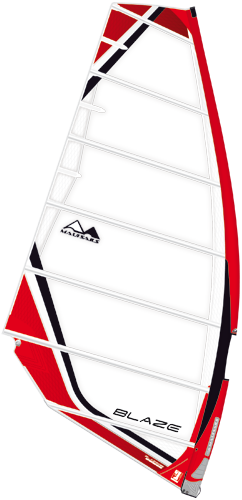


The Cosmic may be a bit too recreational for this application.  It only has 6 battens and 2 cams so maybe not quite man enough for the job.

Camless models to consider are the Severne NCX and the Sailworks Retro.  Both of these sails have huge bottom end power and are extremely fast.  Gaastra's Savage is simply too heavy in this size, weighing at a full kg more than the other two.


2012 Retro 10.0


In this size, I personally use an old Gaastra Nitro5 which I share with Andy (he bought the sail and I supply all the rig components).  The rig comprises my old Gulftech 100% carbon race mast and Fiberspar carbon boom.  The result is a feather light power source, beautifully balanced and as fast as most other sails on the water.  The sail has 4 cams but rotates so easily that one forgets they are there.  All in all a great option in this lineup.


A wildcard to consider if you live and sail in the UK, is the C4 from Demon Sails (I think their big size is 9.2m).  These are the lightest sails on the planet and are designed by two pretty serious engineers who between them possess a vast understanding of aerodynamics, sails and sailing at speed.  These are quirky sails and look like they were designed in 1985 but they are proper high tech machines.


C4            


OK, that's all for now.  Talk to you soon. 

Tuesday, July 10, 2012

Ideal Sail Quiver - 1

Hi all

I've been giving this matter quite a bit of thought and it can be a big topic if one wants to present all of one's thoughts and philosophy on each size.  I don't want to bore anyone so I am going to keep my commentary and reasoning as concise as possible.  I have just had a phone message from Christiaan from Stellenbosch saying that he is looking forward to the sail articles.  When readers have to resort to phone messages to get you to move your ass, you know you have been delaying for too long so here is the first article.

Remember what I stated at the start of the board articles - these recommendations are aimed at the advanced recreational windsurfer who enjoys dicing his or her mates over a wide range of conditions.  They are not aimed at racers, wave guys or freestylers.  Further, I am going to push camless sails as much as possible because I believe that for most of us these sails provide better speed, superior control and much, much more fun in real world conditions than race sails.

In this article I am going to list the sizes that I will be discussing in coming articles.  Here they are :

  • 9.0m with narrow sleeve and the only sail in the range where cams may be an advantage.
  • 7.8m no cam high performance sail
  • 6.5m freeride sail
  • 5.5m freeride sail
  • 4.7m wave sail     
I will be naming the specific brands for each size which I believe offer the best performance on the market today.  I may well miss your favorite brand and leave out some particularly good sail and if I do I apologize in advance but the suggestions made will be good.  

If you recall the boards suggested, you will be able to match the 2 or 3 of the above sail sizes with each of the boards.  Overlaps are essential in our sport and I hope that the sails I am going to suggest, together with the board/fin combinations, will provide some optimal overlaps to keep you blasting at your preferred level of intensity on any windy sailing day.

On the subject of ease of use and comfort, another belief of mine is that any sail which is smaller than 7.0m should have no more than 6 battens.  I find that this construction allows the sail to breathe more freely in strong winds allowing you to keep the board under control far more effectively than with a harder sail.  There are exceptions to this rule of course and if you have a 7 batten sail which is smaller than 7m you can still tame it with a carefully selected, soft mast.

OK so there are the points around which the next few articles are going to revolve.  I will start with the actual   recommendations in the next article.

Good winds     

Wednesday, July 4, 2012

Ideal Board Quiver 3

Hi
I have had quite a bit of e-mail response to the last post and most of it relates to the smallest board in the suggested range.  I knew that this would be the contentious board and that is why I said last time that I would say a bit more about it this time round.  The selection of this board is going to depend on exactly what conditions your sailing spot throws at you in storm strength winds.  It will also depend on your style, proficiency and brand loyalties so one size fits all is not going to be possible.

One way to approach really strong winds is to use the time to develop skills.  You will probably have fierce chop which is difficult to gybe in.  Rather than doing what we do day in and day out (long distance dicing), use the difficult conditions to polish your gybes.  Don't go out further than 50m and use the swells to gybe.  If you make this decision you may go for a wave or a small freestyle board.  Gareth e-mailed me saying that he wants a fast board of less than 56cm wide.  He is set on continuing the normal dicing regardless of the conditions.  Andy too is a speed demon and his choice for a small board is the new Tabou 3S 96 litre.  The 3S is a fantastic board.  It does not give too much straight line speed away but gives a huge amount of comfort over horrible conditions.  Comfort brings confidence and allows one to close the gap and go for it when you would be sheeting out and panicking on a racier board.

Given all of the above, a short list which could meet most requirements is as follows:


  • Rocket Limited 95
  • 3S Limited 96
  • 3S Limited 76
  • Fanatic Freewave 75
  • Naish Grand Prix 80 (for resolute blasters)
These are all quite floaty boards because I am writing this for my fellow blasters.  I find that a very small wave board may be great for a wave sailor but for us, the board can sink in the lulls if the wind is gusty turning your high wind sailing into a nightmare.  The Naish GP is billed as a slalom machine but it is great over chop and has 2 rows of footstrap screw holes so you can de-tune it for comfort over the really nasty stuff.

My personal choice for the smallest board remains the Rocket Limited 95 (this is also highly tuneable with footstrap positions, fin choices etc) but as I said to Gareth I would probably choose the beach when the really hard wind bites in.

That's all for now.  I will be recommending a sail quiver to complement the boards discussed - starting from the next post.

Good winds


Thursday, June 28, 2012

Ideal Board Selection - 2

Hi

This post continues on the topic of selecting an optimal board quiver.  I covered the first 2 slalom boards last time so here is the third and final slalom board I suggest.  This board will be a pure slalom design and will have a width of between 60 and 62 cm.  Recommended models are Starboard's iSonic 90litre/60cm, Tabou's Manta 95litre/61cm, Fanatic's Falcon 99litre/62cm and RRD's X-Fire 98litre/62cm.  Each one of these boards is phenomenal in what it does - dynamite speed with ease of use.  Be sure to take the trouble and time to choose the right fin as this can have a huge effect on ease of use, speed and general enjoyment.  I am suggesting RRD's X-Fire without ever having sailed one but based on reviews on the Internet and my feelings about the brand I feel safe in making the recommendation.
If you are listening RRD, send me a  98 X-Fire and I will get you the most comprehensive test from a large number of good recreational sailors that you will get anywhere. We are fully back on the water from October to March (worth a try!).

The fin for this board will be a Select 33cm S12.  I have used a Deboichet 34 SL4 on the Falcon 99 and it works beautifully but costs more of course.  Try before you buy if at all possible.  This board can be used when the wind strengthens and the water state is not too wild.  It works extremely well with your 5.5m and 6.5m soft sails (to be discussed in coming posts).  This is the board on which you will achieve personal best speeds.  It is the board which will allow you to out pace your mates and may even allow you to frighten one or two race guys on their full blown racing rigs.

Having said all of this, this particular slalom board is probably the one you would exclude from the suggested range if you have cost/space/hassle constraints.  The 95litre freeride board could be used in the above conditions and will work with the same sails.    

x-fire-v4-98

iSonic 90 Carbon
 

The next two boards are the freeride models.  What I suggest is a larger board of around 66cm wide and a smaller board of around 58cm wide.  The ideal boards for our particular conditions would be Tabou's Rocket Limited 115litres and Rocket Limited 95litres.  These particular boards are fast, easy to use and incredibly versatile.  In winter we get winds from the opposite direction to our summer winds and large swells come in from the open ocean.  You need boards suited for sailing at speed over this vastly different water state.  The Rockets are perfectly suited to this type of sailing and are also fast over the wilder, steeper chop which develops in the strong summer winds.  A really good fin for the 115l board will be a Select 39cm S12.  The fin for the 95l board will be the 31cm S12.  The standard fins which come with the boards are fine but better suited for wavy conditions and are a bit vague for serious blasting.

THE NEW  Rocket LTD


If your water conditions are a bit flatter in strong winds then Starboard's Futura could be something to consider if you need a really fast freeride board.  They are not as good as the Rockets over chop but over flatter water are virtually as fast as pure slalom machines.  Awesome designs!  You would go for the Futura  101litre for the big board and 93litre for the small one.  In fact the 93litre model could be a perfect substitute for the 61cm wide slalom.  Save money on a board!  My only reservation is that these boards are virtually slalom in nature so you don't get enough of a differentiation between the two types of board.
Futura 101 Carbon

I have always had a soft spot for Fanatic Hawks as well.  You would be looking at the 110l and the 100l Hawks.  Sebastian has the ability to imbue his designs with a special excitement when you ride them.  I'm not sure how they stack up in pure speed but for sheer fun they are hard to beat.

That is all for now.  In the next post I will discuss some of the issues around the smallest board in the quiver.  I would personally go for the Rocket 95 but you could have sailing conditions which demand a completely different type of board.

Talk to you soon        


Tuesday, June 26, 2012

An Ideal Board Selection - 1


Hi

The purpose of this series of posts is to explore some options with the aim of arriving at an ideal board and sail combination for the fast freeride sailor.  The emphasis will be on equipment lightness, ease of use, fun, and optimising board speed across a wide range of wind and water conditions. 

Some assumptions:
·         You are a sailor weighing between 75kg and 95kg.  If your weight falls above or below this range, you will obviously need slightly larger/smaller equipment.   
·         Your prevailing sailing conditions provide flat water when the wind is light, becoming progressively wilder and bumpier as the wind strengthens.
·         You are not a serious racer or speed sailor but enjoy informally dicing with your mates in a wide range of conditions.
·         You do not want to spend a whole lot more money buying formula equipment.    

The basic rule I use for board selection is that the lighter the wind, the racier your board needs to be.  This means that your big board needs to be a pure slalom shape which is wide and as light as you can find.  As the wind picks up and you change down in size, you need to consider easier board shapes and easier sails.

OK so what are we talking about?
My feeling is that the ideal board quiver would comprise 5 boards - 3 slalom and 2 freeride.  I will discuss the first 2 slalom boards (starting with the biggest) in this post.  

Your Big Slalom Board
Your big slalom board is between 80cm and 85cm wide.  This can be sailed with a 9m and a 7.5ish sail.  My pick for this board would be Starboard’s iSsonic 117Wide in carbon of course. Remember that lightness and ease of planing are paramount for this board.  I am always disappointed to see visiting sailors with large (and frequently heavy) freeride boards.  A light iSonic 107 (for example) will plane long before a heavy Carve 141 or a heavy Tabou Rocket 145 with the same sail and will eat the bigger board on speed.  Why would you lug a heavy, sluggish board around when it gives no advantage on the water? 

Go light and be fast!   


iSonic 117 Wide Carbon


You also need a powerful and compatible fin for your big board.  A cost effective fin would be a Select  s12  -  49cm or last year’s s10 – 49cm.  If you are want to spend some serious money then consider a Z Fins 48cm or a Vector Canefire Carbon  - 48cm.


Z SL


The above images come from Dave Gollick’s site - windsurfingfins.co.uk .   (This is a useful site for sailors who do not have a local fin supplier.  Dave can ship fins to you anywhere in the world.)


If much of your prevailing wind is on the light side you may need a slightly bigger option for your big board – (Fanatic’s Falcon 140 or RRD’s X-Fire 129 for instance) 


Your Medium Slalom Board
Your medium slalom board will be 68cm to 71cm wide.  My first choice for this would be Tabou’s  Manta 71 but Fanatic’s Falcon 113, RRD’s X-Fire 114 and Starboard’s iSonic 107 are all fantastic boards and your choice will depend on personal brand preference or the brands carried by your favourite supplier.  This size of board is a crucial component of your quiver.  It can be ridden in fairly strong winds but is also capable of holding sails up to 9m in size for spectacular light wind blasting.  You need 2 fins and if we stay with Select these would be an s12-39cm and an s12-43cm.  The 43cm fin will go with your 7.8m sail in lighter winds and this allows you to change down to the 39cm fin when the wind picks up.  Keep the 7.8 up and continue smoking.  You’ll be surprised at how much wind you can hold.  When you start getting badly hammered, change down to your 6.5m soft sail (to be discussed).  This ploy works well when the wind is gusty and you need the extra width and flotation in the lulls.  The 39cm fin is extremely happy with the smaller sail.   
                         

OK that is all for now.  I will discuss the smallest slalom board in the next post and will also try to get on to the two freeride boards.  Subsequent posts will discuss the ideal sail quiver to go with the boards recommended.                 


Talk to you soon


PWA Notes


Hi
Sorry for the break but I needed to get away from the blog for a while.  Winter is with us, the weather is cold, dark and wet so windsurfing is not uppermost on one’s mind.
 
The Catalunya stage of the PWA slalom circuit is over and Dunkerbeck powered through to the top of the podium.  The second spot went to Julien Quentel and third was Anton Albeau.  Six of the top ten racers were on Starboard iSsonics confirming just how potent these boards are.  Three of the top 5 sailors were on Severne Reflex sails reminding us once again of the high levels of performance which can be accessed from these technical sails by skilled riders.

Points of interest are as follows:
·         Well done Julien!  This is the best performance we have ever seen from this accomplished racer. 
·         Cyril has shaken off his dodgy start to the tour and made 5thposition.  It seems that he is getting to grips with his Reflex sails.
·         Taty Frans on Starboard and Maui Sails came in at 10th.  It is always interesting to watch a freestyle sailor competing in slalom.  My feeling is that most of these guys probably find slalom boring but their skill levels are so “off the chart” that when one of them joins the fleet, I watch with interest.  Once the area of race tactics has been mastered watch out!
·         The first Gaastra rider was Alberto in 12th place and the first Tabou guy was Arnon at 13th.  The Mantas are fantastic in rough water but when things smooth out they are probably slightly behind the Starboards and RRD’s.
·         Ross Williams, despite a really good showing at the last event came in at 20th

That is all for now.  I plan to explore the ideal board and sail combination for the advanced non-racing windsurfer in the next post.
Good winds  

Wednesday, June 6, 2012

PWA Stuff and Sail Issues


Hi
I’ve been back for a while but needed a rest from the blog. 

On the PWA front Micah was the winner in Korea – a good result for a great guy.  He was always going to be on the podium but was quite lucky to get first place because Antoine Questel rounded the wrong bouy in a crucial heat.  The organisers need to be a bit better at marking the race bouys so that they stand out for the racers (maybe a luminous red flag on top of each marker).  Anyone who has raced on a busy piece of water knows that there is always a plethora of markers (mooring bouys, yacht guides, kelp markers etc) and it can be difficult for the guy in front to identify exactly where to go.  Things can look completely different looking back at the beach to what you envisioned when standing on the shore.  Anyway a great pity for Antoine but good luck to Micah.  As I said before, I am surprised to see him do so well because my feeling is that both JP and Maui Sails have fallen behind a bit in slalom design this year.  I may be wrong.

Finian has been plagued by bad luck – firstly by cutting his heel open on a broken bottle,  then he broke a fin in a crucial heat and then went on to snap his boom in another so we have yet to see the new Avanti sails in full flight.  Peter Volwater is doing OK.

Another surprise for me is the performance of Cyril Mousillmani.  When he moved to Severne, I predicted big things from him but he has not done much.  Bjorn on the other hand is flying on the new Reflexes.  Even when he gets a bad start he invariably screams through the field with ease.  I am beginning to suspect that set-up and sailing style are a huge factor with the Reflexes.  If you get everything right for yourself, you have the fastest thing on the water but if you don’t mesh 100% you can find yourself slightly off the pace.   Andy, one of our local power sailors gets awesome performance from his Reflex but some of the other guys seem to be struggling a bit with theirs.  I have a feeling that the North Warp and the Loft Blade are both easier to tune and handle even if they are not quite as fast.

The third guy on the podium was Ross Williams who showed real flashes of brilliance in some of the heats.  For the last two years Ross has done nothing on this circuit and now he suddenly looks like a contender.  As I have said before, the new Vapors are really good now and the new Manta 71 will be playing a big role in this turnaround.  The Z Fins that Ross and Alberto use seem so well matched to the Vapors as well.

If you are a regular reader you will know that I am in the process of replacing my cammed sails with cammless  ones.  This is because I believe that I am faster on lighter, easier sails than I am on hard core slalom models.  I am only speaking for myself here.  If you are a strong, athletic sailor and you want to win races you need race sails – no question but I think I can do better on the softer stuff.  I recently replaced my Ka Koncept 6.6 with a Gaastra Cross 6.4 and plan to replace my North Ram 7.8 with a Gaastra Savage 7.8.  My concern is that I will spend a whole lot of money only to find that the Savage is harder than the Ram and perhaps not quite as powerful.  I have always believed that as soon as you get to sizes above 7.0m you need cams to give you that extra bit of power in the light winds.  I am challenging this belief with the new path but it will be interesting and I will report back when our season starts up again in October/November.  Gareth, my sailing partner uses a 3 cam 7.5 (7.6?) and it will be interesting to compare when we get back on the water.  Our boards are quite similar.

We had a fantastic sail here on Saturday – a bonus for us as winter is upon us and the prevailing summer wind has gone but the gods smiled and we blasted.  Joos - our doctor, his daughter Karo, Brett – a hard core English sailor, Ellie and I all had a great session.  I alternated between my 7.8 and the new 6.4 and both performed beautifully.
I’m away again on Friday for a week but will talk to you when I get back.
Good winds.